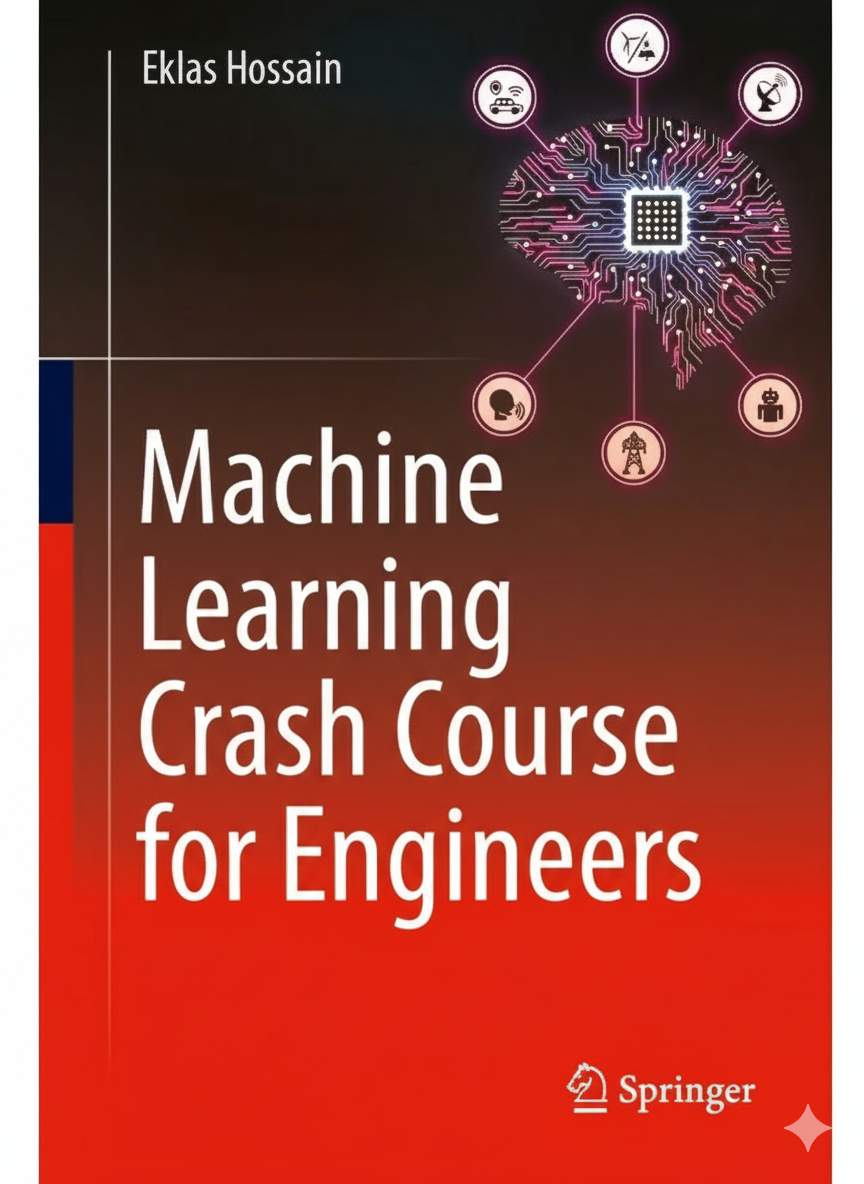
Professional and Marketing Summary of the Book: “Machine Learning Crash Course for Engineers”
Technical Sheet and Author Information
Author: Eklas Hossain
Affiliation: Department of Electrical and Computer Engineering – Boise State University (USA)
Specialization: Electrical Engineering, Computer Science, and Applied Artificial Intelligence
Expertise: The author combines scientific rigor with engineering pragmatism, making Machine Learning accessible to technical professionals.
Publication Information
Full Title: Machine Learning Crash Course for Engineers
Publisher: Springer Nature Switzerland AG
Publication Year: 2024
ISBN (Print): 978-3-031-46989-3
ISBN (eBook): 978-3-031-46990-9
DOI: https://doi.org/10.1007/978-3-031-46990-9
Programming Language Used: Python (NumPy, scikit-learn)
Educational Objective of the Book
This book serves as an intensive course for engineers and professionals seeking to quickly acquire a solid foundation in Machine Learning and apply it directly to technical projects.
The author emphasizes operational understanding rather than pure theory, with real-world engineering examples of ML applications.
Main Structure and Content
1. Introduction and Fundamentals
-
Understanding the role of Machine Learning in modern engineering.
-
Exploring the main learning paradigms: supervised, unsupervised, and reinforcement learning.
-
Learning the key steps of data preprocessing: cleaning, normalization, and feature selection.
2. Supervised Algorithms
-
Linear and logistic regression.
-
Classification using KNN, Naive Bayes, and SVM.
-
Practical use cases: diagnostics, predictive maintenance, and quality control.
3. Advanced and Ensemble Models
-
Decision Trees, Random Forests, XGBoost, and Gradient Boosting.
-
Applications in complex systems and multivariable predictions.
4. Neural Networks and Deep Learning
-
Understanding Perceptrons, MLP, CNN, and RNN architectures.
-
Case studies: image processing, signal analysis, and time series.
5. Unsupervised Learning
-
Clustering techniques: K-Means, DBSCAN.
-
Dimensionality reduction: PCA.
-
Applications in engineering data segmentation.
6. Evaluation and Optimization
-
Cross-validation and performance metrics (accuracy, recall, F1-score, ROC).
-
Model optimization: regularization and hyperparameter tuning.
Target Audience
-
Engineers (Electrical, Mechanical, Civil, Computer, etc.)
-
Developers and Data Engineers integrating AI into technical systems.
-
Advanced students (Master’s, PhD, Engineering Schools).
-
Anyone with a foundation in mathematics and Python programming.
Reasons to Buy and Marketing Strengths
-
Accelerated and Targeted Training: A true crash course designed for fast operational readiness.
-
Hands-on and Pragmatic Approach: Immediately applicable to real-world technical projects.
-
Universal Programming Language (Python): The global standard for modern Machine Learning.
-
Springer-Endorsed Publication: A guarantee of academic rigor and scientific quality.
-
Strategic Tool: Essential for remaining competitive in engineering and innovation sectors.
Conclusion and Key Benefits
Machine Learning Crash Course for Engineers is a fast and efficient gateway into the world of industrial Machine Learning.
It enables readers to transition from theory to practice in record time and implement reliable predictive models in real-world environments.
Through its clear explanations, project-oriented structure, and practical examples, this book is an indispensable guide for engineers seeking to master data, automation, and applied artificial intelligence within their field.
Official Notice – BIG DATA CONSULT
BIG DATA CONSULT holds the exclusive resale rights for this book in French-speaking Africa.
Anyone purchasing the book from the official platform www.bigdataconsult.fr
receives lifetime access to the digital version, along with supplementary educational resources (course materials, exercises, quizzes, and updates).