Détails du livre

Téléversé par : Isaac NDJENG
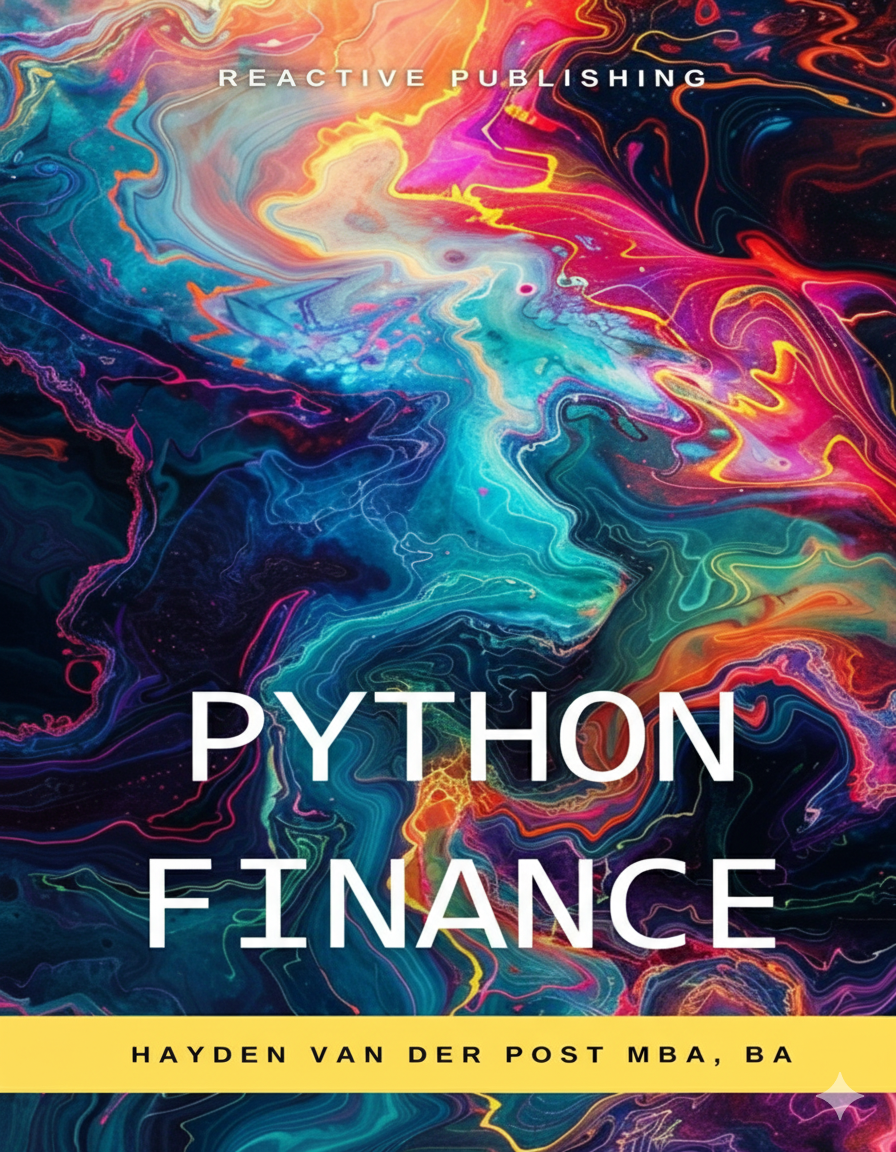
Collection : Python Finance: Harnessing the Power of Python for Financial Modeling and Quantitative Analysis
Date de mise à jour : Sat, 20-Dec-2025
Nom de la catégorie : Technologie & Informatique
Author: Hayden Van Der Post, MBA, BA
Publisher: Reactive Publishing
This book is a complete and practical guide to applying Python in quantitative finance, designed for students, finance professionals, analysts, and developers who wish to master financial modeling, data-driven decision-making, and algorithmic trading through modern programming techniques.
Bridging the gap between financial theory and computational practice, the book demonstrates how Python can be used to automate, model, and analyze complex financial systems. It combines rigorous mathematical foundations with hands-on coding applications, making it a key resource for anyone looking to advance in the field of quantitative finance.
The book begins with an introduction to the core principles of quantitative finance, including the role of mathematical modeling, risk-return optimization, and computational thinking.
It then provides a step-by-step guide to setting up a Python environment and using essential libraries such as NumPy, Pandas, Matplotlib, and SciPy for financial data analysis and manipulation.
This section develops the mathematical and statistical background required for financial computation, covering:
Time series analysis and forecasting,
Probability distributions and stochastic processes,
Inferential statistics for hypothesis testing and parameter estimation.
These tools form the analytical backbone of modern finance and investment science.
The author explains how to model and simulate key financial instruments — including equities, bonds, and derivatives — and how to apply Python to retrieve, clean, and interpret market data.
Readers learn to calculate returns, volatility, beta, correlations, and other market metrics to support portfolio decisions.
A major part of the book is devoted to Modern Portfolio Theory (MPT) and quantitative portfolio optimization. Topics include:
Risk-adjusted return analysis,
Construction of efficient frontiers,
Portfolio diversification using covariance matrices,
Performance measurement using metrics such as Sharpe and Sortino ratios.
Python is used throughout to automate and visualize these calculations.
The book explores the design and implementation of quantitative trading algorithms, guiding readers through:
Strategy formulation and signal generation,
Backtesting methodologies,
Execution and transaction cost modeling,
Performance evaluation and refinement.
It offers code-driven examples of trend-following, mean reversion, and momentum strategies implemented in Python.
This section focuses on advanced risk modeling techniques and the valuation of complex financial instruments.
Readers learn about:
Volatility modeling (ARCH/GARCH models),
Value-at-Risk (VaR) and Conditional VaR,
Monte Carlo simulations for derivative pricing,
Option valuation using Black-Scholes and binomial models.
The final section introduces data visualization best practices, teaching how to create:
Time-series plots, correlation matrices, histograms, and risk heatmaps.
It also includes a Python reference guide summarizing key programming concepts, data structures, and workflow optimization techniques.
By the end of the book, readers will be able to:
Understand and apply the mathematical and statistical foundations of quantitative finance.
Build and evaluate financial models and trading algorithms using Python.
Develop automated workflows for market analysis and portfolio optimization.
Gain practical insights into risk management, derivatives pricing, and data visualization.
This resource serves as both a learning manual and a reference guide for professionals in asset management, risk analysis, and quantitative research.
| Element | Detail |
|---|---|
| Title | Python Finance: Harnessing the Power of Python for Financial Modeling and Quantitative Analysis |
| Author | Hayden Van Der Post, MBA, BA |
| Publisher | Reactive Publishing |
| Key Topics | Quantitative Finance, Financial Modeling, Portfolio Management, Algorithmic Trading, Risk Management, Python Programming |
| Target Audience | Quants, Finance Professionals, Developers, Students, Data Scientists |
Please note that BIG DATA CONSULT holds the resale rights for this publication on its official website:
www.bigdataconsult.fr
| Titre | Python Finance: Harnessing the Power of Python for Financial Modeling and Quantitative Analysis | |
|---|---|---|
| Producteur du contenu | Isaac NDJENG | |
| Collection | Python Finance: Harnessing the Power of Python for Financial Modeling and Quantitative Analysis | |
| Edition : | Reactive Publishing | |
| Nombre de page | 498 | |

3000 FCFA

Isaac NDJENG est le fondateur de BIG DATA CONSULT, expert en reporting financier et Business Intelligence. Fort de son expérience dans les BIG 4 et certifié en Business Analytics, il accompagne les entreprises dans la valorisation de leurs données et la montée en compétences digitales en Afrique francophone.


Étudiez n'importe quel sujet, à tout moment. Explorez des milliers de cours au prix le plus bas de tous les temps !